Bauxite – Day 4 of the Mineral Advent Calendar

This holiday season, why not get a mineral every day instead of chocolate? Today’s mineral is Bauxite, find out more about it below..

Wherever you go at this time of year you can’t turn around without being presented with delicious baked treats! Cinnamon, nutmeg and ginger are EVERYWHERE and they smell deeeeelicious!

ALL THE CHRISTMAS COOKIES! (Image from Wikipedia)

ALL THE CHRISTMAS COOKIES! (Image from Wikipedia)

But in order to shape these yummy delicacies you need cute snowflake, gingerbead men and star shaped cookie cutters. The best cookie cutters are made with aluminium and to find  aluminium for the cutters you need an ore like Bauxite.


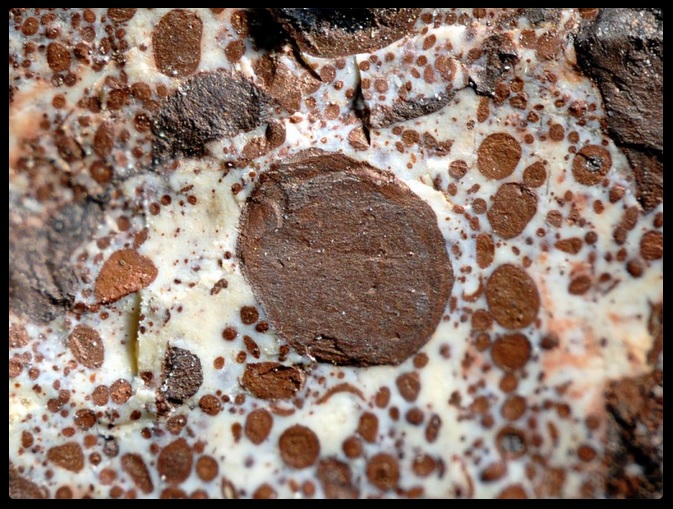
Bauxite photo from the MinDat website, taken by Chris Auer.

Bauxite photo from the MinDat website, taken by Chris Auer.

Bauxite:

Chemical formula: Al(OH)3
Colour: Shades of brown, pink and orange
System: Amorphous
Hardness (Mohs): 1 – 3
Can you find it in the UK? No

Bauxite is not actually a mineral, but, similar to Monazite, the term describes a group of minerals that represent the primary ore of aluminium. These minerals include Gibbsite, Bohmite and Diaspore and although it is not a particularly attractive mineral is extremely valuable commercially. Unfortunately it isn’t found in the UK (as far as I know – please correct me if I’m wrong!), but you can find it in nearby France!

For more information about Bauxite please visit the MinDat website.

Cerussite – Day 3 of the Mineral Advent Calendar

This holiday season, why not get a mineral every day instead of chocolate? Today’s mineral is Cerussite, find out more about it below..

One of my favourite things about this time of year is tucking up under a nice blanket with a hot chocolate and a seasonal film! And there are so many to choose from:

I love seasonal movies - have you watched Elf yet? WHY NOT!?! GO watch it as soon as you have finished this post!

I love seasonal movies – have you watched Elf yet? WHY NOT!?! GO watch it as soon as you have finished this post!

But in order to watch these cinematic gems (*excuse the pun) you need a nice shiny LCD television (or similar). If you want your TV functioning in full technicolor (even if you are watching a classic like ‘Christmas in Connecticut’) you need lead – and you get that from minerals like Cerussite.

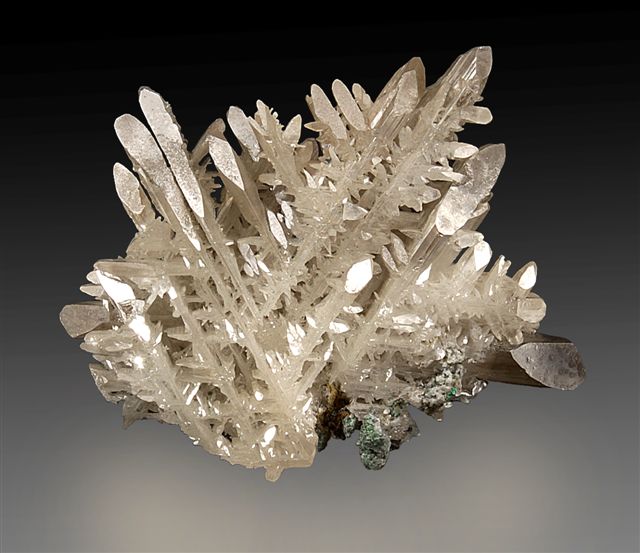
Gorgeous Cerrusite (this photo is from Wikipedia), many more gorgeous images of Cerussite are available on the MinDat website!

Gorgeous Cerrusite (this photo is from Wikipedia), many more gorgeous images of Cerussite are available on the MinDat website!

Cerussite:

Chemical formula: PbCO3
Colour: Colourless, white, gray, blue, or green
System: Orthorhombic
Hardness (Mohs): 3 – 3½
Can you find it in the UK? Yes

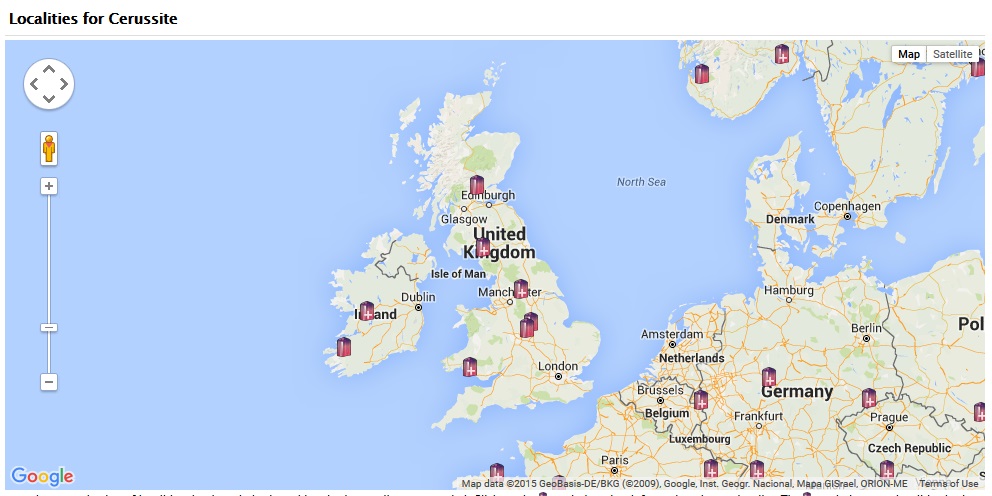
Locations registered for Cerussite in the UK, from the MinDat website.

Locations registered for Cerussite in the UK, from the MinDat website.

Cerussite is a lead carbonate mineral and is commonly formed as a result of weathering of Galena and other lead ore minerals. Cerussite can be found in several locations across the UK, but is not commercially mined in this country.

For more information about Cerussite please visit the MinDat website.

Monazite – Day 2 of the Mineral Advent Calendar

This holiday season, why not get a mineral every day instead of chocolate? Today’s mineral is Monazite, find out more about it below..

Yesterday we looked at the first thing we see that makes us think of winter-joy, but today I’m going to talk about the first thing you hear, and that of course is the ubiquitous Christmas Songs Playlist, that seems to be on loop in practically every store from the end of October.

I love some seasonal music, but how would i listen to it if my speakers didn't work!

I love some seasonal music, but how would I listen to it if my speakers didn’t work!

Now personally I have always been more of a fan of this kind of music:

http://www.youtube.com/watch?v=Bo4hI0LdsFg

or this:

Than this kind of music, which is more of what you hear in the shops…

But regardless of which kind of seasonal song you like, you wouldn’t hear them at all without minerals like Monazite and that is because Monazite contains Neodymium – a Rare Earth Element (or REE) that makes all your speakers do their jazzy, seasonal thing.

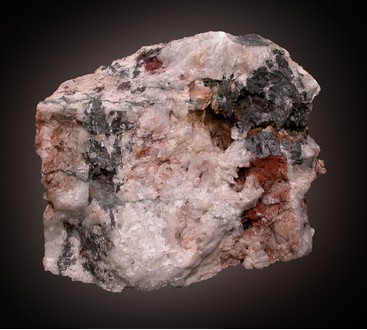
A picture of Monazite (Nd) from MinDat website, taken by Enrico Bonacina

A picture of Monazite (Nd) from MinDat website, taken by Enrico Bonacina

Monazite (Nd):

  • Chemical formula: (Nd,La,Ce)(PO4)
  • Colour: Orange brown, yellow to pink
  • System: Isometric
  • Hardness (Mohs): 5 – 5 1/2
  • Can you find it in the UK? Yes
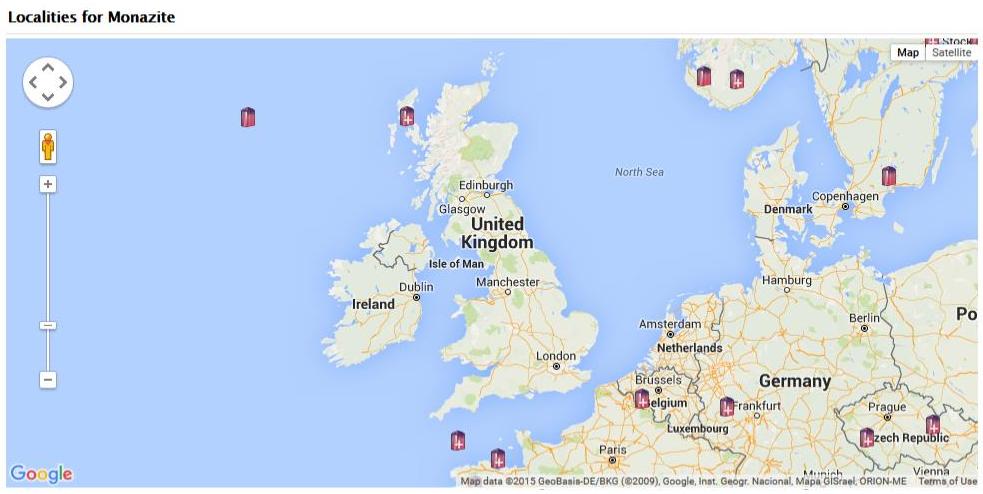
Locations registered for Monazitein the UK, from the MinDat website. The crystal in the sea between Cornwall and France, should actually be on Cornwall!

Locations registered for Monazite in the UK, from the MinDat website. The crystal in the sea between Cornwall and France, should actually be on Cornwall!

Monazite is actually the name of a group of minerals with similar chemistry and features that have different amounts of various REE in them. Monazite can be found in Cornwall and Skye in the UK, but is not commercially mined in this country.

For more information about Monazite please visit the MinDat website.


Wolframite – Day 1 of the Mineral Advent Calendar

So it’s December the 1st and across the nation people are opening the first window of their advent calendars. But instead of chocolate, why not get a mineral every day?! Over the next 25 days I will post a new mineral related to an aspect of the holiday season for your enjoyment.

After all, what says mid-winter more than sparkles!

Sparkling christmas lights

Everyone likes sparkly lights in winter, but they wouldn’t work without tungsten – and for that you need Wolframite.

To kick us off, I’m looking at the first thing that most of us notice about the season – sparkling lights! It wouldn’t be winter without strings of glittering lights everywhere, but those lights wouldn’t function without tungsten, a metal found in the mineral Wolframite.

A photo of a specimen of Wolframite form Drakelands Mine in Devon, taken by Paul De Bondt from the MinDat website: http://www.mindat.org/photo-471032.html

A photo of a specimen of Wolframite form Drakelands Mine in Devon, taken by Paul De Bondt from the MinDat website.

Wolframite:

  • Chemical formula: (Fe2+)WO4 to (Mn2+)WO4
  • Colour: Greyish-black
  • System: Monoclinic
  • Hardness (Mohs): 4 – 4 1/2
  • Can you find it in the UK? YES
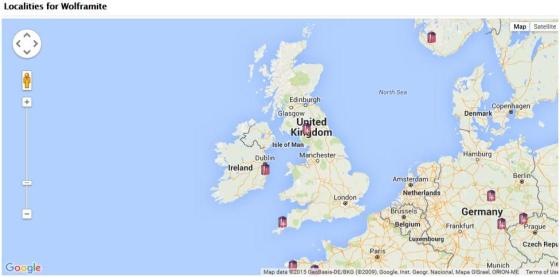
locations of wolframite from mindat website

Locations registered for Wolframite in the UK, from the MinDat website. Does not yet include new mine site just outside of Plymouth – Drakelands Mine.

Wolframite is one of the UK’s currently mined minerals, thanks to a new mining development that has recently started production just outside Plymouth in Devon. Tungsten is considered so valuable because of it’s resilience to high temperatures, which makes it ideal for use in many new technologies – including lights!

Drakelands mine visit - summer 2014 - Hazel Gibson

A view across the Drakelands mine site taken from a mine visit organised in sumemr in 2014 beofre the mine entered production stages.

For more information about Wolframite please visit the MinDat website.

For more information about the new Drakelands Mine please visit the Wolf Minerals website.

Women can understand fracking!

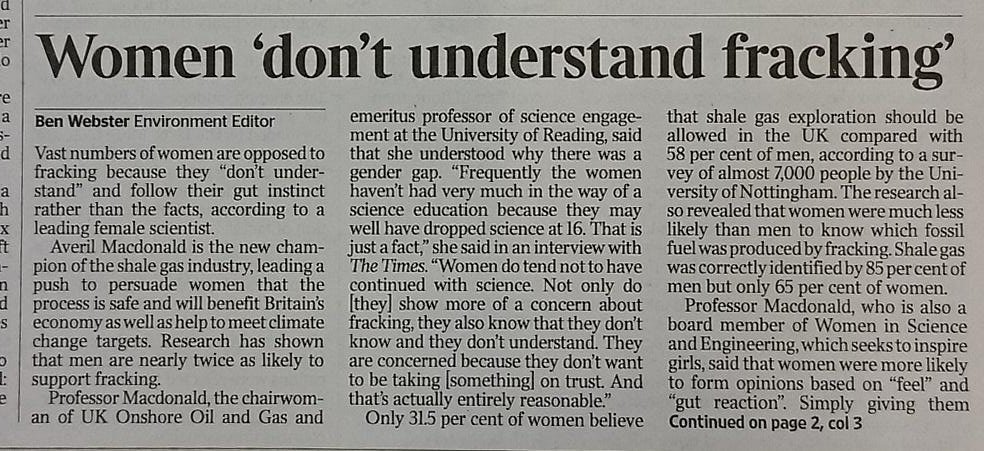
Women 'don't understand fracking' article in the Times from @EbenMarks

Women ‘don’t understand fracking’ article in the Times from @EbenMarks

This morning I was sent an article from the Times titled ‘Women ‘don’t understand fracking’. This article was forwarded to me because my research into what people think about geology has occasionally brushed onto fracking and as such I have a very keen interest in how people think about fracking and what impacts on the decisions that they make about it. Professor Macdonald’s comments were perceived as controversial, and the article opened with:

“Vast numbers of women are opposed to fracking because they ‘don’t understand’ and follow their gut instinct rather than facts, according to a leading female scientist.”

The article went on to quote a study done by the University of Nottingham, which stated that 31.5% of women believe that that shale gas exploration should be allowed in the UK as opposed to 58% of men, and that 65% of women identified shale gas as the product of fracking as opposed to 85% of men (the article said ‘correctly’, but as you can extract different types of fossil fuels using fracking including oil and methane – I would want more info before drawing that conclusion).

The specific Nottingham University study itself was not made clear in the article, but it is here and it forms part of an ongoing series of studies about how we in the UK perceive shale gas extraction and fracking. The studies have provided many interesting results, but the focus on gender highlighted in this article has raised concerns. I was asked in the context of my work – had I found any gender bias in this issue of how people perceive geology? The short answer to that is not yet. The long answer is that I am less interested in the influence of gender and so am not specifically looking at that factor, and also that most of my data is still qualitative and so I would not want to draw general conclusions at this point.

But I wouldn’t be surprised if I did.

It seems to be true that there is a gender difference in the way that men and women perceive science in general and fracking in particular – the work done by Nottingham is good and should be trusted. This issue here for me is more about the context of that difference. The article mentions that women may have less access to science education because they may not have continued science (or any STEM subject) post 16, and that would lead them to feel less confident in their understanding of science. The article then continued with the statement from Professor Macdonald:

“women are more likely to form opinions based on ‘feel’ and ‘gut reaction.”

The quote is continued in another article (as the Times is behind a paywall and I only got a small part of it):

“Merely showing them more facts demonstrating that fracking was safe would not change their minds, she said.“Why are men persuaded? That’s because an awful lot of facts have been put forward,” she said. “[Men] will say, ‘fair enough, understand’. But women, for whatever reason, have not been persuaded by the facts. More facts are not going to make any difference. What we have got to do is understand the gut reaction, the feel. The dialogue is more important than the dissemination of facts.”

(continued from the Telegraph)

What this article fails to do, is separate two very important issues:  the difference between access to science for different genders, and how having a science education can make you feel more confident in discussing and debating science issues. The problem, as I see it is this:

  • Girls are less likely to access science (or STEM) post-16 than boys

AND

  • If you have not had a science education, then fact-based science communication is harder to engage with.

What it doesn’t mean is that women are less able to engage with science than men, that’s a fallacy of logic. There are men who didn’t engage with science post-16 that struggle with fact-based science communication, just as much as there are women who have had access to post-16 science education who are completely comfortable with fact-based communication.

Working with girls from my old school on a STEM day (photo from the Herald Express)

Working with girls from my old school on a STEM day (photo from the Herald Express)

The context that is missing from this article is culture. Women have culturally, for hundreds of years, been told that science is not for them, so they don’t engage with education. When someone of any gender doesn’t engage with education, it becomes harder to understand the intricacies of that subject later in life. What I have found in my research, and what I increasingly believe to be true, is that most people regardless of their gender want to know more about fracking, but the answer to that thirst for knowledge is not just facts. As communicators we need to take into account the different influences on people’s lives and not just expect them to understand and agree with us when we present them with data.

So really I think this comes back to the title of this piece – ‘Women ‘don’t understand fracking’. Well maybe, for deeper cultural reasons, this is true – but actually I think the headline should read, ‘Women (like men) CAN understand fracking’ and it’s our job as science communicators to help make this happen.