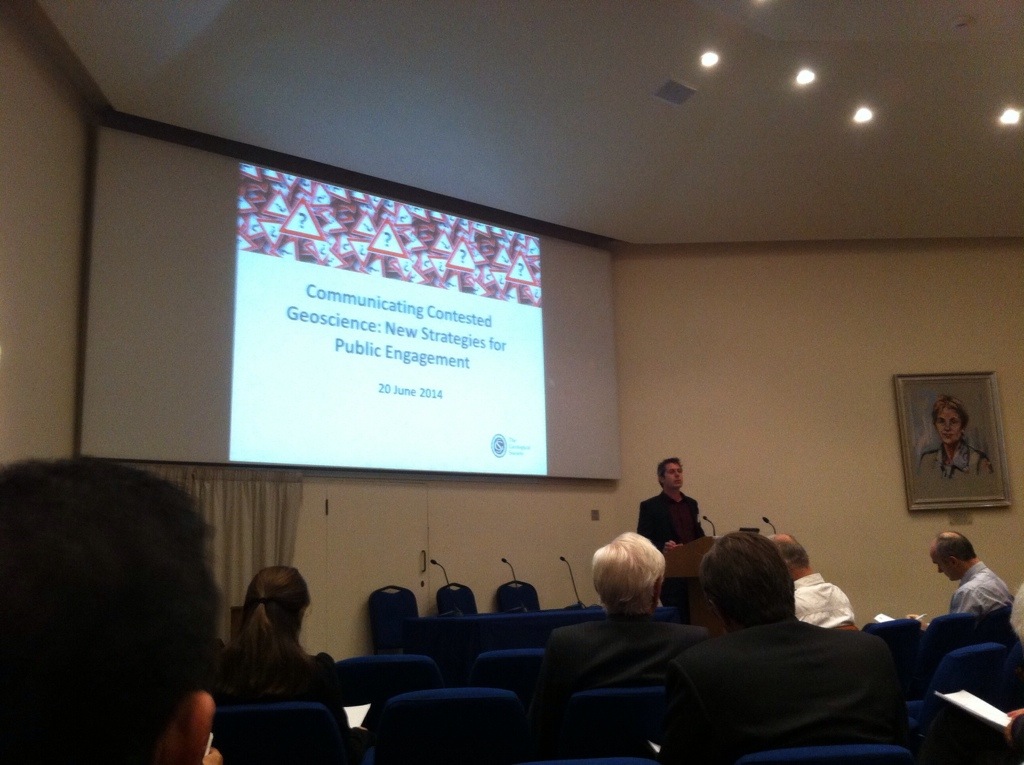
On Friday 20th June I attended the Communicating Contested Geoscience conference at the Geological Society’s Burlington House. The title for this conference was ‘new strategies for public engagement‘ and it was focused on three of the more controversial geological subjects in development at the moment; carbon capture and storage, radioactive waste disposal and fracking for shale gas. The day featured speakers from across a wide range of public bodies and private companies, academia and industry and provided a brilliant synopsis of many of the biggest issues with communicating these subjects that geologists see today.
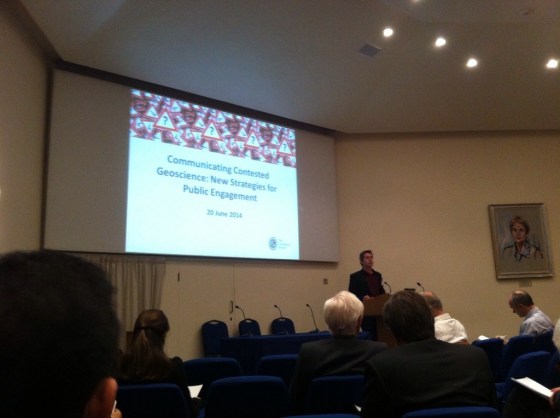
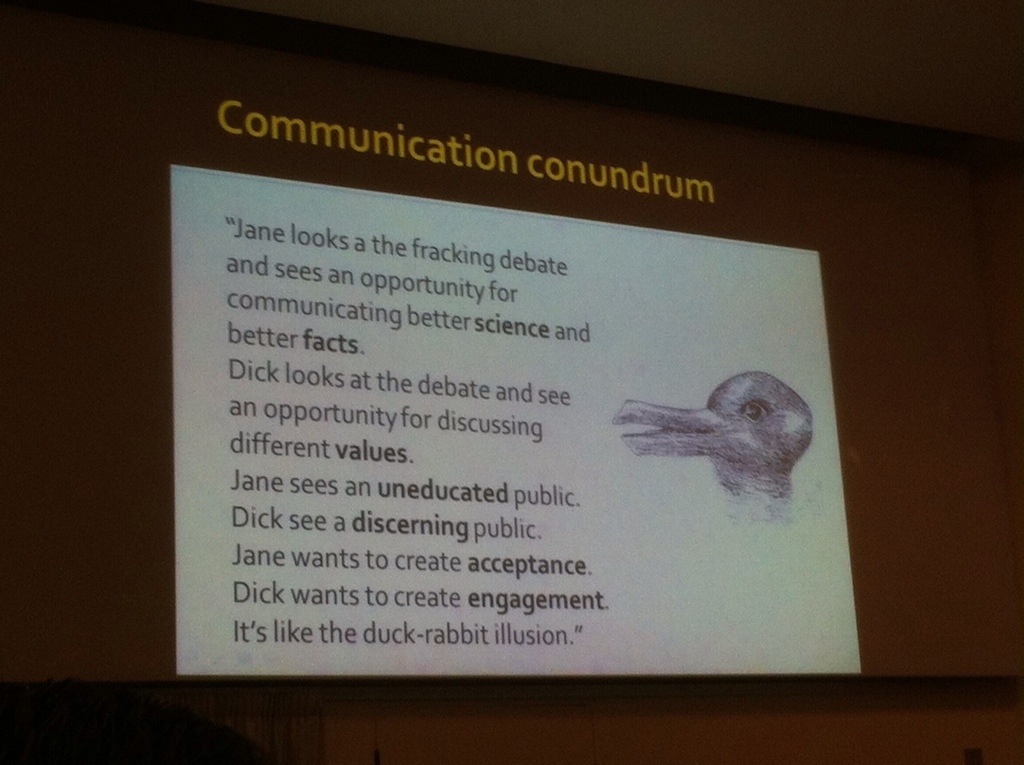
The day was started off with Prof Iain Stewart talking about our responsibility to communicate what we do to the public and that reliance on the old style deficit model is no longer an option. The idea that ‘if we can get the science and then just tell that to the public then they will understand’ is no longer the case; as trust, relationships and fear all play a part in how the public respond to our attempts at communication.
David Manning, the new president of the Geological Society gave the first talk of the day, reflecting on the role of geoscientists in society and the responsibilities of large organisations like the Geological Society to provide facts that allow people to make their own decisions. He mentioned that it would be next to impossible to fully represent their members’ opinions as with 12,000 members it wasn’t unreasonable that they would have to represent 12,000 opinions! He also introduced what was to become a central concept of the day, the role of the three pillars of sustainability – environmental, social and economic and the role of these in communication.
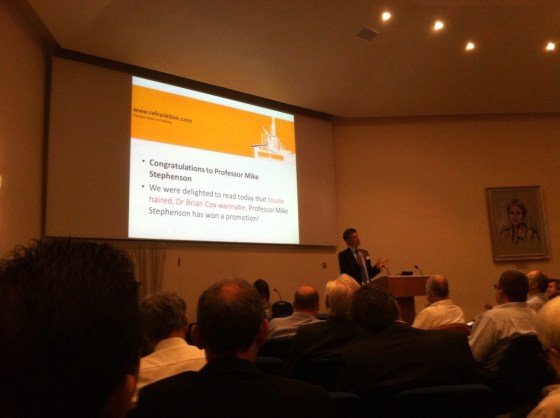
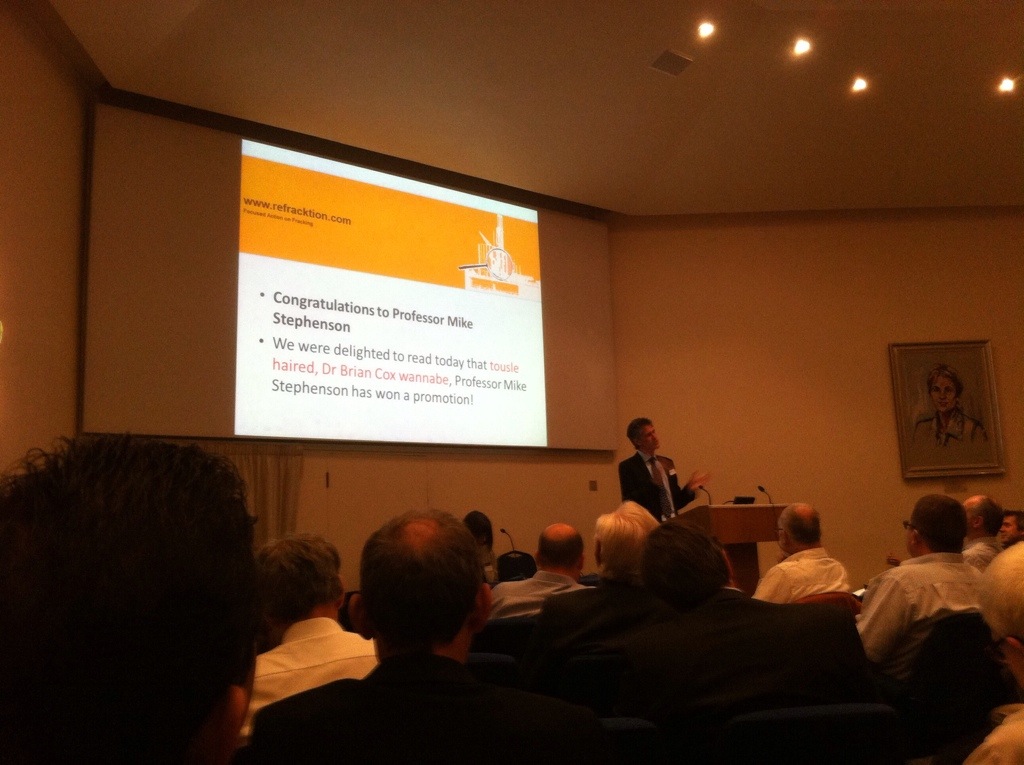
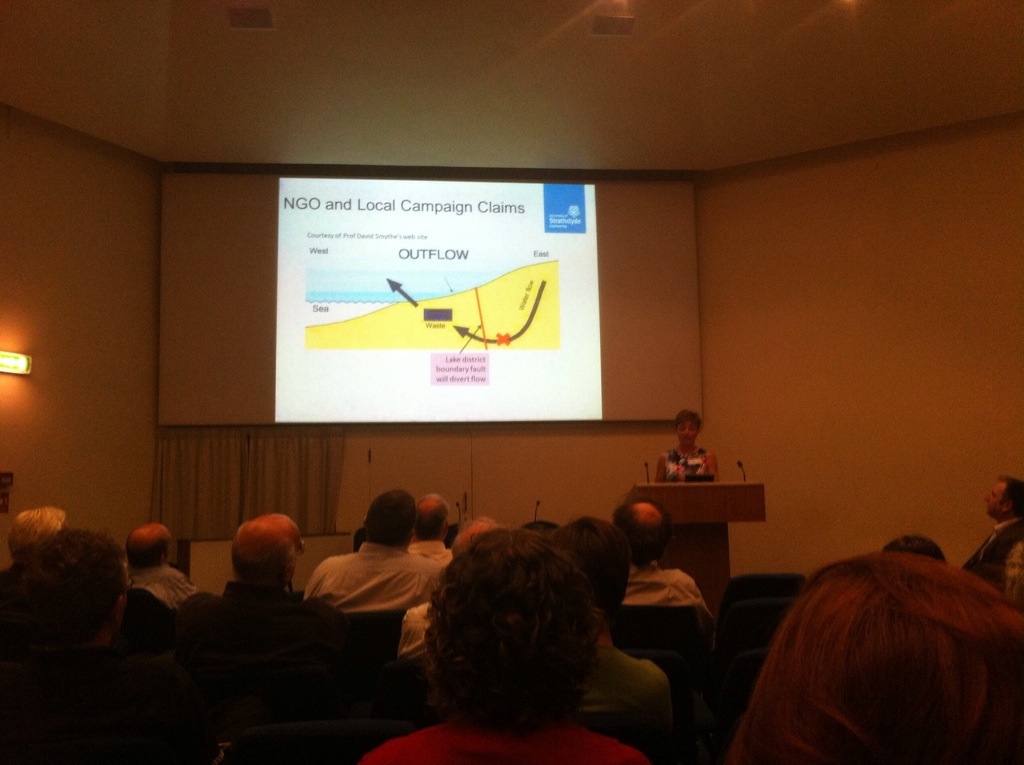
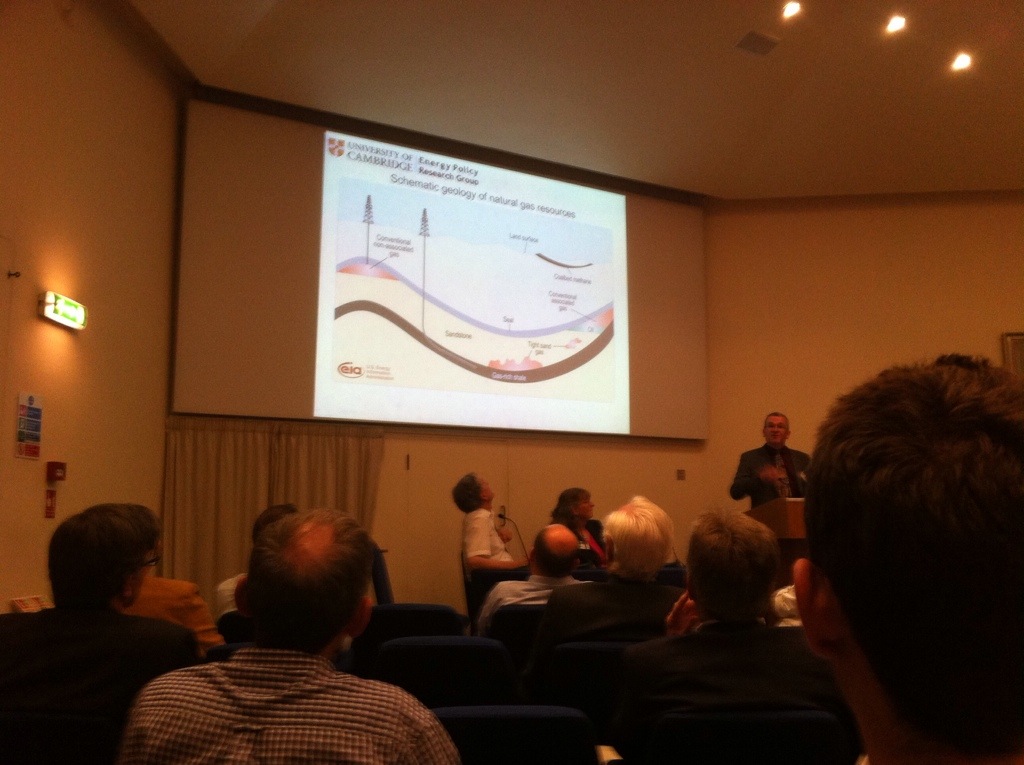
The first session addressed one of the most high profile examples of the difficulty of communicating our geoscience – fracking for shale gas. It was chaired by Zoe Shipton from Strathclyde University and the panel consisted of David Mackay from DECC and the University of Cambridge, Mike Stephenson from the BGS, Brigitte Nerlich from Nottingham University and Mark Lappin formerly of Dart Energy. The shale gas session was always going to be one of the most difficult and was frequently threatened to derail in pursuit of technical issues, but Dr Shipton did an excellent job of keeping everyone on the Communication track. The session looked at the uncertainties of shale gas resources, comparing them to various renewable technologies, the changing nature of public engagement, the influence of the media and what is ‘the community’. The panellists also took a look at perceptions of the need for gas – brilliantly exemplified by a tweet sent from the protesters at Barton Moss “Urgently need gas for cooker!”
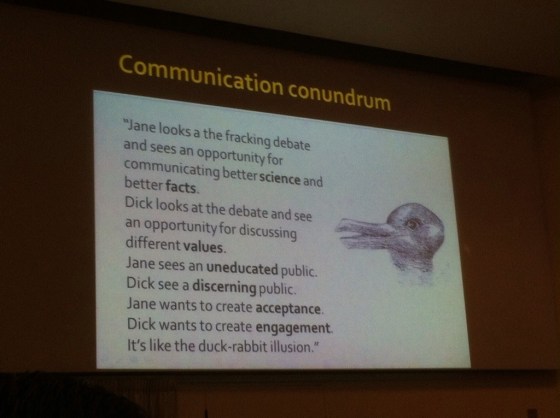
At the end of this session spirits were running high and a number of good discussions on how to build and maintain trust and effective ways to engage with the community were explored and whether more or less data was better for transparent communication and understanding. One interesting point raised by a member of the audience was on the nature of risk – that it’s often easy to dismiss risk for the public because we know the statistics, but for the average person that risk is not approached in the same way.
The second session of the day was about CCS (or Carbon Capture and Storage). The panel was chaired by Clair Bond from the University of Aberdeen and consisted of Andy Chadwick from the BGS, Jon Gluyas from Durham University, Kirsty Anderson from Global CCS and Clair Gough from the Tyndall Centre and the University of Manchester.
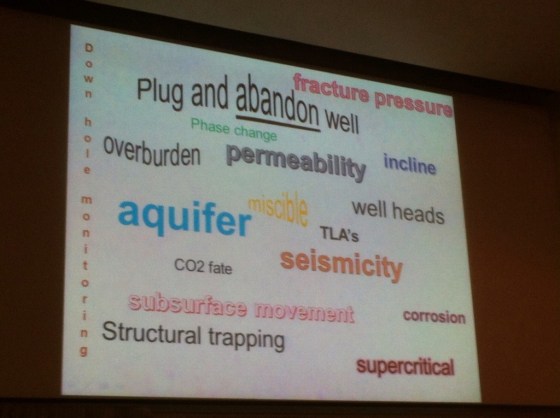
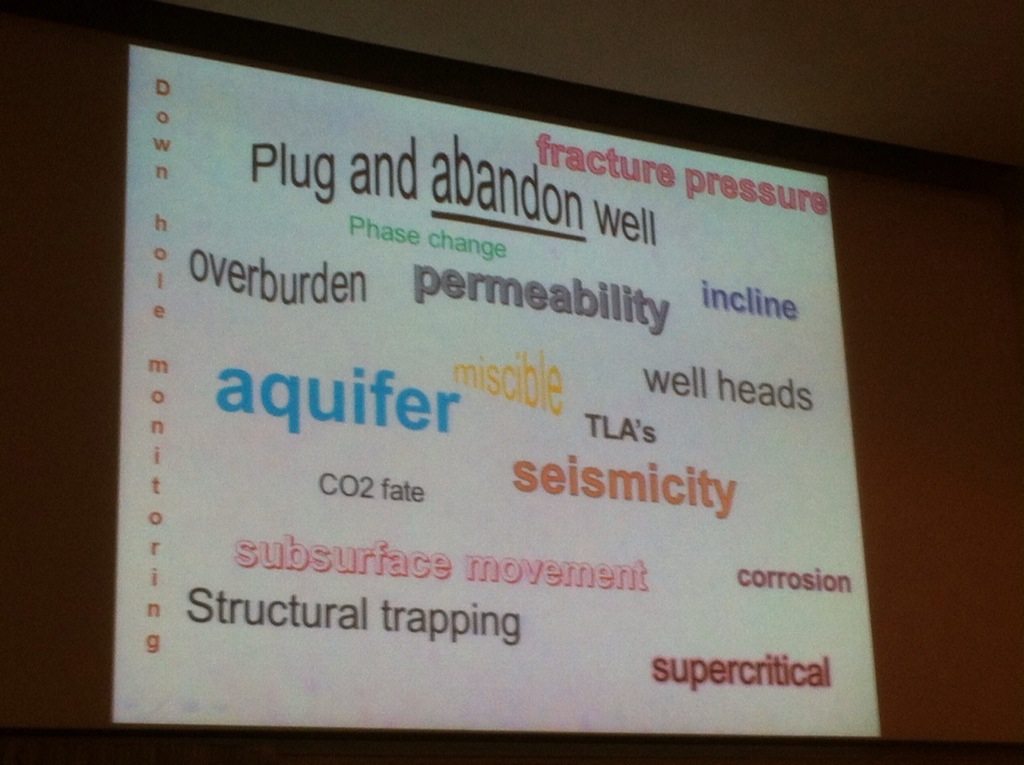
Although this session focussed on a range of ideas from the difficulty of communicating scales – even accurate ones – to understanding the societal context and peripheral issues of CCS, one of the best talks in my opinion came from Kirsty Anderson of Global CCS, the only non geologist on the panel. Kirsty talked about the value of having an embedded communication strategy at all levels of the project team and also stressed the importance using target communications early – which does not mean going to a paper early, but engaging with stakeholders and other key influential people. She also highlighted how words that we see as innocuous actually can leave a lasting impression – such as to ‘plug and abandon the well’ may leave thoughts of poor little abandoned orphan wells all over the country!
We came out of that session mulling over the idea that controversial does not necessarily mean conflict, but that it is actually a critical element of the debate, which should not be ignored, suppressed or managed away.
The third session of the day focused on Radioactive Waste Disposal. The session was chaired by Nick Smith from the University of Manchester and featured Rebecca Lunn from the University of Strathclyde and the Committee on Radioactive Waste Management (CoRWM). The panel was also made up of the two Bruces; Bruce Yardley from the Nuclear Decommissioning Agency and Bruce Cairns from DECC, and Phil Richardson from Galson Sciences.
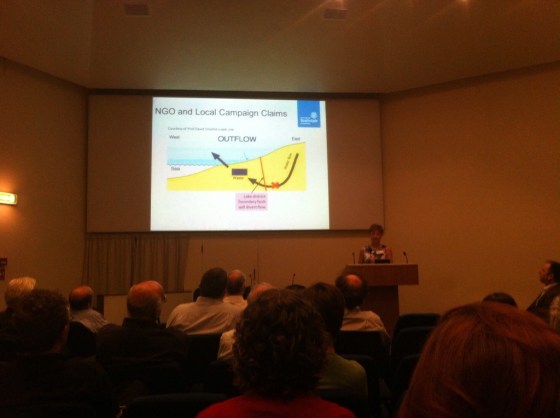
This session was interesting as it looked at the pressing issues of radioactive waste disposal – how much waste we have already and the need for long term solutions – and how they make this a particularly challenging issue. In addition the obvious notions about what makes secure storage are not necessarily true – in some locations a fractured geological storage can be used as the geology itself is not necessarily the barrier to flow, but what keeps the engineered barriers in place. Once again there was lots of discussion about when to communicate and how to get in touch with communities, but was interesting was how the discussion had started to shift back towards the deficit model of communications. The discussion became less about dialogue and more about information transfer – what to tell people, not how to engage them.
The final session focussed on the central issue to all the topics of the day – public engagement. The session was chaired by Iain Stewart, the keynote was presented by Nick Pidgeon from Cardiff University and the panel consisted of Ruth Allington from GWP Partners and David Reiner from the University of Cambridge.
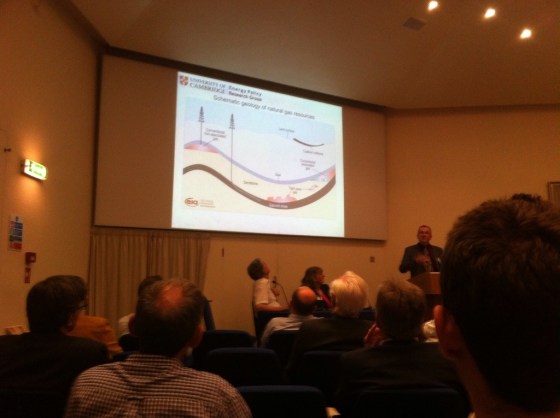
This was almost a summing up session, exploring the social context of risk and how we apply local issues to the national question, but also about the importance of images and of a balanced mediation in dealing with the public and industry. However, after these issues were raised in the presentations, focus of the questions seemed to slide back to information transfer. It almost seems like we need to get this discussion fully out of our collective scientific system before we can move on to new methods and approaches.
The day was closed by the fantastic Paul Younger from the University of Glasgow. His light-hearted and humorous presentation reminded us that we are a community that needs to stick together and that although it is easy to be critical of ourselves as a community, we don’t actually do that badly – and at least, with conferences like today’s we are attempting to improve our approach. He ended by singing us a little song to remind of why we do any of this at all –
‘the things we do for love’.
(photo from the-geek-goddess)
For more info and links check out the Storify.

 My Patchwork Planet