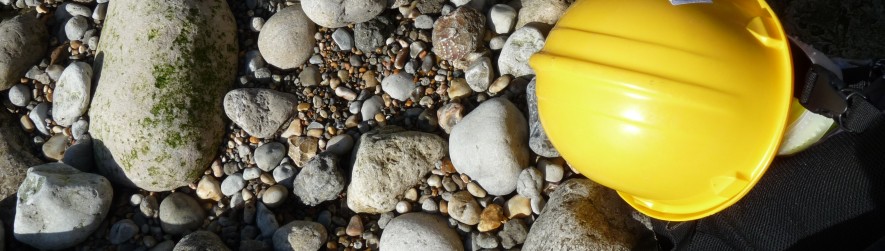
Did you know you live on an ancient desert?!

On Saturday I was in the Royal Albert Memorial Museum in Exeter (RAMM) helping to run a specimen handling collection called ‘Local Finds’. It’s a great initiative that brings objects out from the collections of the Museum and makes them available to the public to handle and explore on their own terms, with someone who knows or loves the objects there to talk with the visitor about them. As a volunteer working with the specimens you can choose which mini-collection to work with; animal bones, hand axes (flint tools), seashore items, ceramics, or geology. I, obviously, chose the geology one – both because I know a bit about the specimens selected and I LOVE talking to people about geology (come on it’s awesome!)!!

Local Finds at RAMM

A selection of some of the objects you can handle at RAMM in Exeter.

There are a number of really interesting objects in the geology tray – a lump of cassiterite (a tin bearing mineral that miners in the southwest have searched for for hundreds of years), a piece of pre-victorian slag (or industrial waste – the remains of metal smelting) a bit of limestone with loads of fossils in it, a selection of fossilised shells and invertebrates, and a coprolite. Now for those of you who don’t know, a coprolite is fossilised poo. Additionally, as anyone who has ever talked to children about trace fossils (those fossils that are left behind by the creature, but not the actual remains of the creature – footprints, burrows, tooth marks etc) will know, a piece of fossilised poo is one of the most entertaining things to engage children with about geology and can really highlight how much the child (or adult) knows about fossils. For example, one of the people I spoke to was a little girl, about 8 or 9 years old, who homed in on the fossils on my table like a shark in the water! Picking up the coprolite she said:

Girl: What’s this?

Me: What do you think it is? (again – a science communicator’s favourite question – if in doubt ask this!!)

Girl: Is it a fossil?

Me: It is, what made you think that?

Girl: Um I dunno, it looks like a fossil.

{Interlude – a bit of dancing around what it looked like and what kind of fossil it might be eventually lead us to…}

Me: Well it’s not a normal fossil, clearly and it was found in Lyme Regis. Does that give you any clues, have you been there?

Girl: Oh, is it a coprolite?

{Mum looks over in amazement}

Me: That’s right!

Girl’s little sister: What is a coprolite?

Girl: It’s a fossil poo!!

{Mum looks even more amazed, whilst girls giggle over fossil poo and have a smell to see if it is still smelly, which they eventually decide it’s not, because ‘it’s really old and has become a rock’}

Me: So it’s a fossil poo, from what creature?

Girl: A pliosaur?

At this point the girls’ mother comes over and really gets involved with the interaction. We work out that because the coprolite has scales in it (probably from fish) and because of it’s size, it’s likely from an ichthyosaur rather than a pliosaur. The girls move off to speak to my colleague about some animal bones and I get chatting with the Mum. It turns out she comes from Torquay, near me, and she mentions how she doesn’t always know what to do with her girls’ interest in science – she doesn’t really feel confident in encouraging them and so is frequently surprised by how much they know. She gave the impression that she loves how much they obviously enjoy science, but doesn’t know how best to support them. Luckily Torquay is in the middle of a Geopark – a kind of area of celebration about geology, because it’s really fabulously interesting! Trust me.
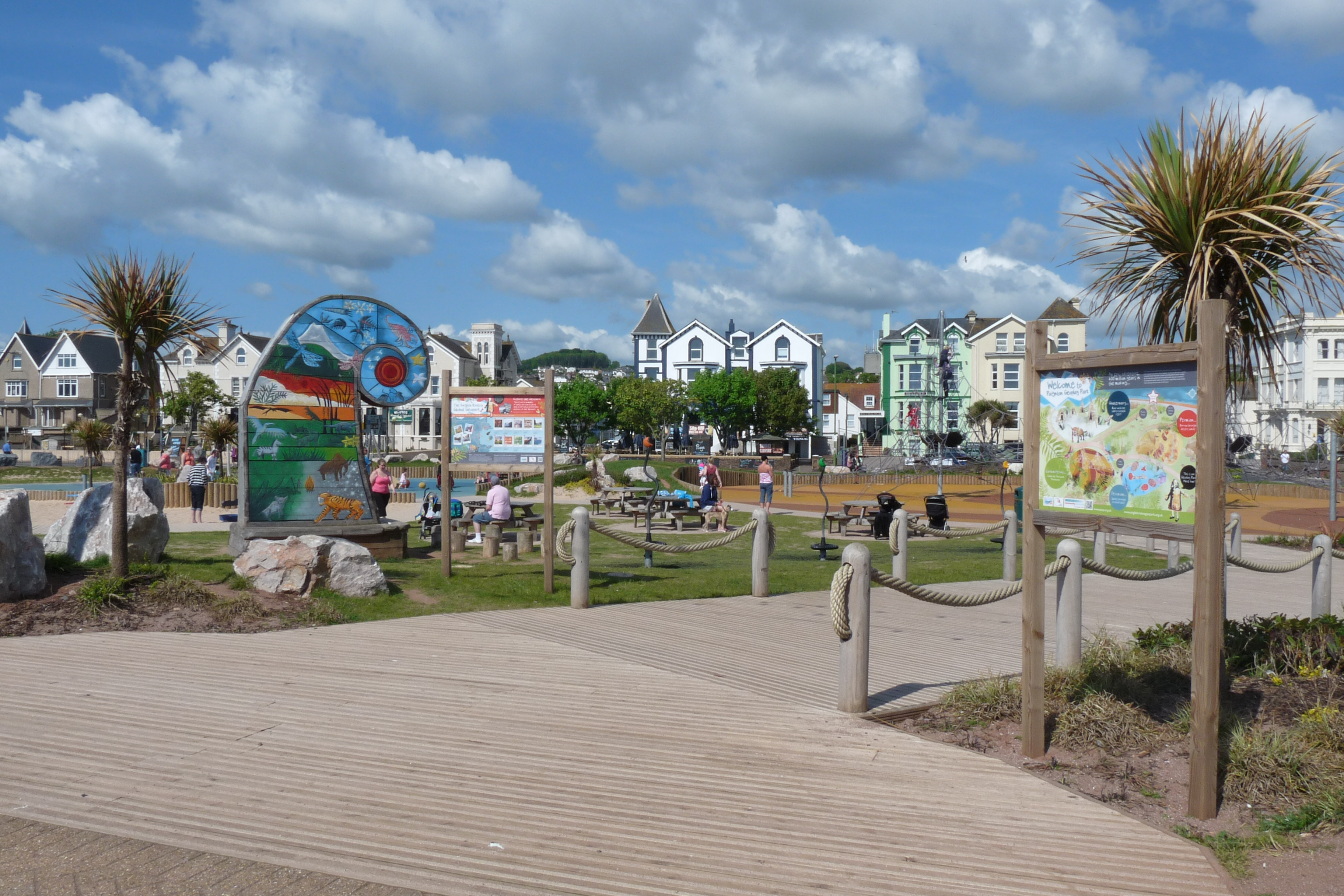
The English Riviera Geopark

The Geopark has lots of aspects – this is a geo-themed playpark; where was this when I was a kid?! Jealous.

This lead to a discussion of some of the best things to see and do in Torquay if you are into geology, but also made me have a bigger idea. If you could share two geological ideas about your area with someone who is interested, but isn’t sure how to find more, what would they be? For me, Torbay (my immediate area) has two really big selling points. First our sand on the beach is red. Like  a bright ochery orange. I didn’t realise how strange this was as I’ve grown up with it, but some friends who visited me recently were amazed – red sand!

This for me was awesome geo-idea about Torbay number 1

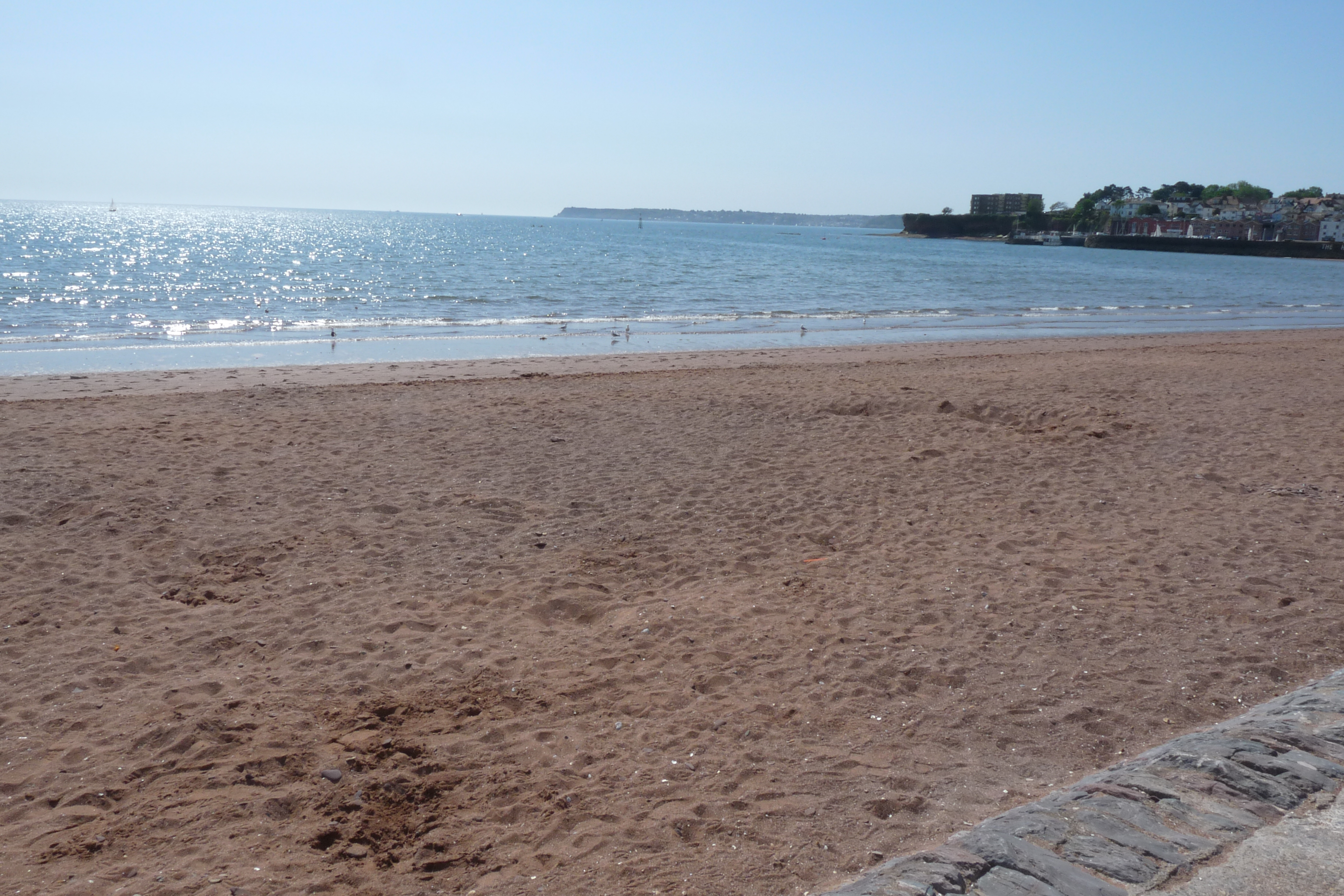
Red sands of Torbay

The red sands of Torbay, ok it’s a sunny day which bleaches them out a bit, but you get the idea.

Torbay used to be a desert. A really big desert. And it was a desert for a long time – about 40 million years – from 290 million years ago to 248 million years ago! This for me is one of the great things about sedimentary rocks, you just think about where in the world, today, would you find materials like what the rock is made from and you have a good idea of the environment that existed when the rock started to form. So I was talking to this lady about geology in Torquay and we started talking about the red sand and where else in the world do you see red sand? The Sahara Desert! So by using the idea above, she got the idea that she was living on an ancient desert!

But one idea is not enough, the next idea followed on from this by moving from taking the familiar and realising something unfamiliar, to finding something familiar in a place you would never expect.

Awesome geo-idea about Torbay number 2….

Gold from Hope’s Nose © Ian Jones

There’s gold in them there hills! Yes it’s true. Whilst most of Torbay is characterised by the Red Sandstone rocks deposited during the desert locked Permian Age, the very tip of Torquay headland is limestone, laid down in a warm shallow sea many years before in the Devonian Age (Devon-Devonian, right?). This part of Torbay is called Hope’s Nose. Now aside from a wealth of small fossils, shells, corals and the like, there are a lot of interesting minerals that can be found at Hope’s Nose. Some of these minerals are so unusual that the area has been legally protected and designated a Site of Special Scientific Interest (so the motto if you want to visit is look but don’t touch any minerals you see). One of these unusual mineral is in fact, gold. A strange form of dendritic (meaning plant like) gold has been discovered, right here, in the English Riviera! Now let’s be realistic, it was a very small amount, but it existed – and surely thats exciting? I wonder how many school children in the bay know that one of the most sought after substances in the world may still lie in tiny amounts, right under their noses?! Not to mention brand new mineral discoveries like Chrisstanleyite!

So those are my two favourite ideas about Torbay, an area often shunned by geo-enthusiasts for her flashier coastal neighbour Lyme Regis, or more austere inland aunt Dartmoor, but fascinating to me.

What about you, does your local area have hidden geo-gems?

References:

Paar et al (1998) A new mineral, chrisstanleyite, Ag2Pd3Se4, from Hope’s Nose, Torquay, Devon, England

Russell (1929) On the occurence of native gold at Hope’s Nose, Torquay, Devonshire

Stanley, Criddle and Lloyd (1990) Precious and base metal selenide mineralisation at Hope’s Nose, Torquay, Devon

Warrington and Scrivener (1990) The Permian of Devon, England
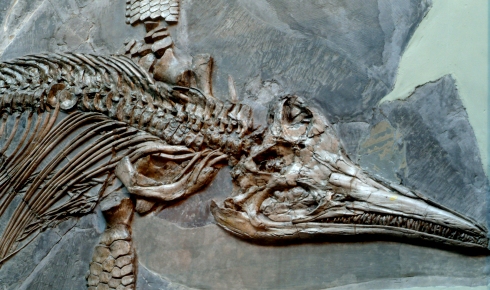
Walk like a dinosaur…

Last weekend, for those of you who don’t already know, was the Lyme Regis Fossil Festival. This festival is a celebration of geology and palaeontology in the UK (and to some extent abroad). Lyme Regis, in Dorset, is the perfect location for a festival like this because it is the home of Mary Anning – one of the first citizen scientists (or citizen geologists more specifically). Mary came from a poor background and, when her father died, it fell to her and her brother Joseph (the only surviving children from 10 born to their parents, Richard and Mary) to support themselves and their mother. Mary collected many fossils washed from the cliffs in Lyme Bay and made some of the most astonishing discoveries of the period – notably early Ichthyosaur, Plesiosaur and Pterodactyl skeletons. Mary herself, however, had little education and the description and identification of these fossils was handed over to the eminent (male) Victorian scientists of the time, including William Buckland, Henry de la Beche and William Conybeare. Because of her background, education and sex, Mary wasn’t credited with the discoveries of any new species’. She did have, however, a vast knowledge of geology and anatomy from her experience collecting the fossils, but even with that knowledge she was never considered a true Victorian scientist.

The idea of a citizen scientist seems like a new one to us, with initiatives such as OPAL ( the OPen Air Laboratory) and the RSPB’s Big Garden Birdwatch using the observations of ordinary folk to assist in discoveries about the natural world, but actually the idea is an old one with a new name (and perhaps, better organisation). The UK is fairly unusual in the number of amateur societies that exist to study organisms that may be – to most people – fairly obscure. Are you really enchanted by earthworms? Then the Earthworm Society of Britain is for you. Mad about mushrooms and toadstools? Try the Dorset Fungus Group. But how do you get people interested in these rather specific areas of science in the first place? Well that brings me back to the value of a Fossil Festival.

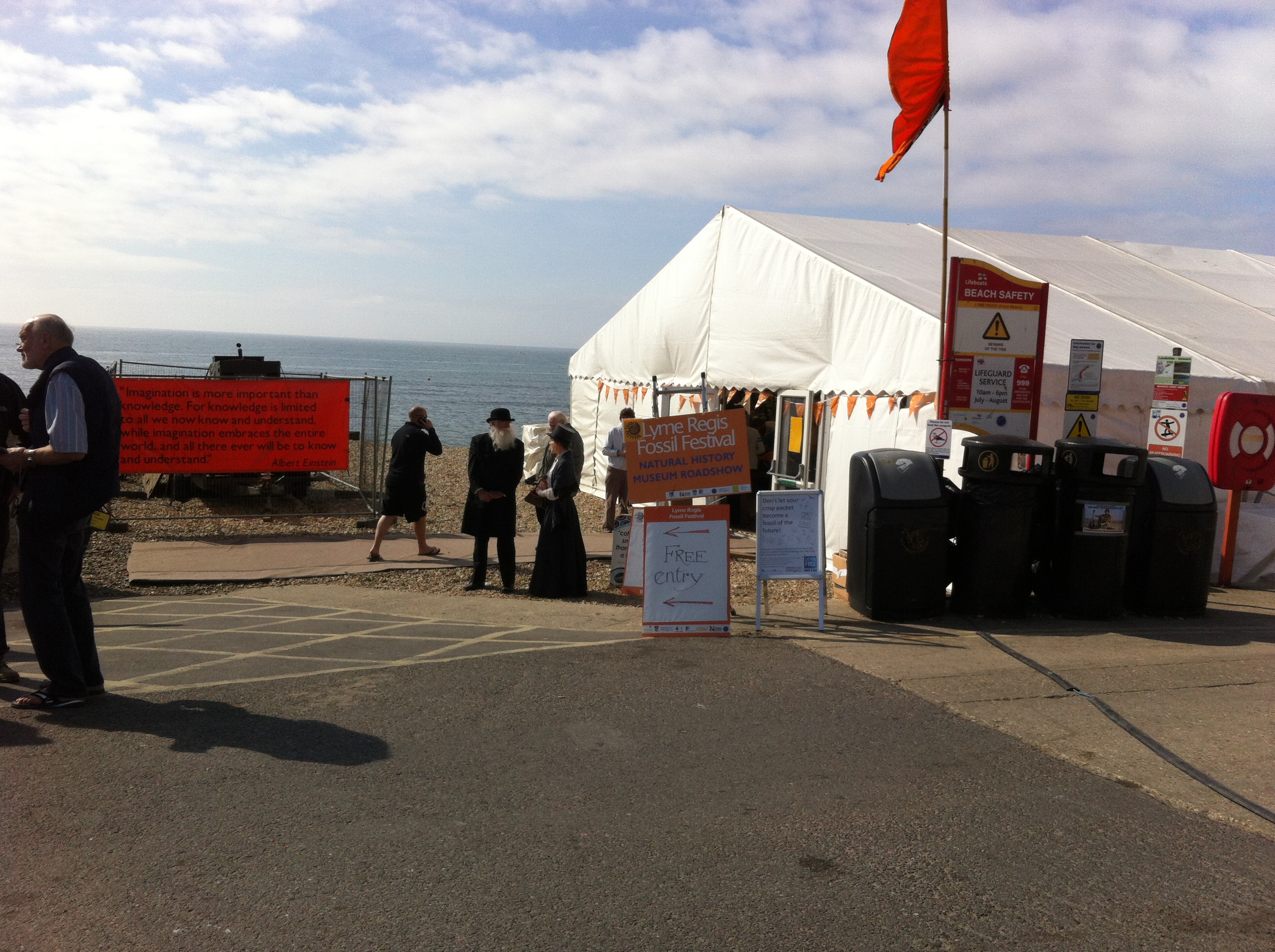
It was a sunny Bank Holiday weekend in Lye Regis - with some characters from British Science History tempted out by the nice weather...

It was a sunny Bank Holiday weekend in Lyme Regis – with some characters from British Science History tempted out by the nice weather…

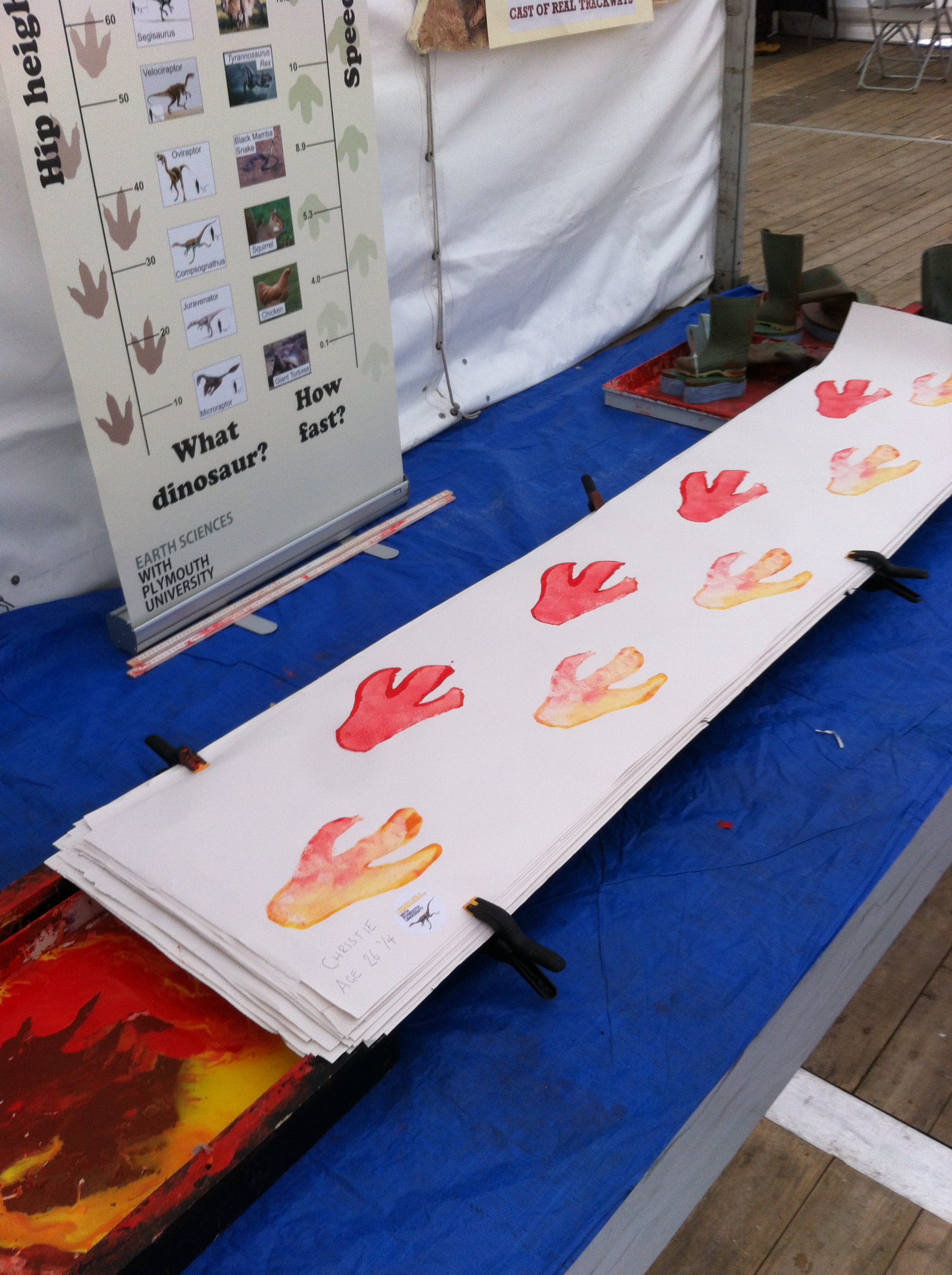
At the Fossil Festival, I (as a part of the University of Plymouth) helped with running an activity called the ‘Dinosaur Runway’ – basically it does what it says on the tin, we got children to put on a pair of boots with ‘dino-shaped-tracks’ on the bottom, and walk down the runway. Why? Because it’s fun (and it really is – you should try it next year). But also because it tells a story about science. This one activity represents several scientific ideas. The first is that dinosaurs leave behind trace fossils (teeth scars on bones, faeces, footprints, etc), that can tell us about the dinosaur itself. One of my favourite is the debate as to whether dinosaurs cared for their young after they laid the eggs and footprints can tell us much about this – if they had cared for their young then surely the footprints would show adults walking with young dinosaurs (although I always think of what a footprint trace from humans in central London would show, to demonstrate how interpretations can be influenced). Additionally, you can tell a lot about how dinosaurs moved by their tracks; were they upright, walking on two legs (bipedal), did they walk on all four legs (quadrupedal) or was it a mixture of the two? So everyone who tried our dino runway, hopefully got an idea of what fossilised footprints represent – some of them had a debate about it – which is the central idea.

The famed University of Plymouth Dinosaur Runway!

The famed University of Plymouth Dinosaur Runway!

The next idea that this activity represents, is the involvement of maths in science. Yes, you could get paint everywhere and make a huge footprinty mess, but without the maths (or trigonometry in the case) you couldn’t work out which dinosaur you represented. By measuring the pace length of the dinosaur and jimmying around with trigonometry we could calculate a rough ‘dino  hip height’ for the person doing the experiment. Which then correlated to a certain species – giving you your dino identity. If your footprints weren’t clear enough, or there weren’t enough of them, the calculations couldn’t be done; leaving your dinosaur identity a mystery – as is actually the case with many dinosaur tracks, they are simply unidentified because there is not enough information. So maths can solve mysteries, but a lack of information will confound your ability to make an identification.

The third idea is that of repetition of an experiment. Because our activity was fun and we catered for a variety of ages of children we were popular at the Fossil Festival, meaning we usually had a queue. That meant that our ‘dino’s in waiting’ got to see the experiment done over and over again – always in the same way. This has value for someone who in school may only have the opportunity to see an experiment done once (even if lots of people are doing it together) as it highlights how much of scientific investigation can be repetition. And how important it is to be able to reproduce your results. If you took a measured stride along our runway and were identified as Deinonychus, then went back and took the same measured stride, you would be identified as Deinonychus again. Repetition and replicability.

At the end though, I think I come back to the idea of it being fun because it is the most important. OK so the dino runway could probably have been more scientifically accurate – and the hip measurements were not exact, but rather fell within a dinosaur species ‘catchment’; but if you focus on those small points you miss the bigger picture – because our activity was fun it could inspire people to go out and try searching for footprints or trace fossils themselves. Or even just trying to interpret something they see without waiting for an explanation first. Nothing we did was wrong, it could just have been more detailed, but sometimes I think (as long as the detail is there for those who want it), a little bit of paint splattered fun is just what science needs.

After all, Mary Anning may have been a citizen scientist to pay the bills in the early 1800s, but I bet she still enjoyed it and that’s how citizen scientists are made – a bit of encouragement, a bit of fun and a lot of curiosity. I think we all have that in us.

So go on – walk like a citizen scientist.


For more information on dinosaur track interpretation see:

Dinosaur footprints in the Wealden at Fairlight, East Sussex (1993) Parkes

Jurassic dinosaur tracks and trackways of the Cleveland Basin, Yorkshire: preservation, diversity and distribution (2003) Romano and Whyte

Fossil footprints from the Dakota Group (Cretaceous) John Martin Reservoir, Bent County, Colorado: New insights into the paleoecology of the Dinosaur Freeway (2012) by Kukihara and Lockley

(if you know of any other good papers about this then please mention them!)

Tell me a story…

Are you sitting comfortably? Then I’ll begin....Much of what I do in science communication involves trying to engage non-scientists, or perhaps those who wouldn’t usually be interested in science with the intriguing and compelling nature of my favourite subject. Now this is a big ask when you consider, people are BUSY! If science isn’t something that you are interested in then why would you even be somewhere that I can talk to you about science, reading a science blog, listening to a science podcast or watching a science TV show? Most of these formats require the audience to come to you (to some extent at least). If you depend only on the regular folks that attend such events or watch such shows – and it’s usually because they have children and see it as some kind of required ‘educational’ experience – then you are missing out on a huge group of people that could find a passion for the subject, or just realise that it’s not as boring or intimidating as they thought. Science communication has been getting better at this recently with the expansion of the work of scientists such as Ben Goldacre, Brian Cox, Iain Stewart and Alice Roberts into the ‘popular’ realm. But to some extent you still depend on your audience to come to you.

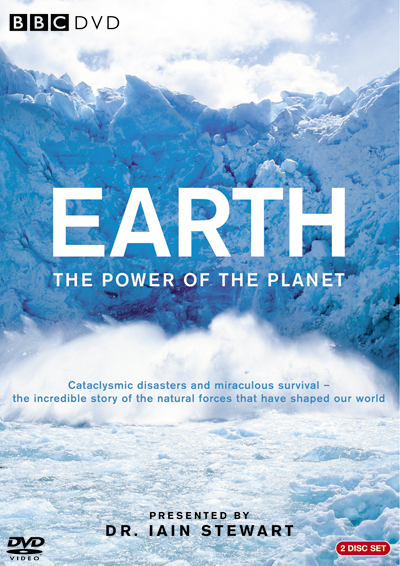
BBC production of Earth would probably have mostly been watched by people who were science enthusiasts or at least curious - what about everyone else?

BBC production of Earth would probably have mostly been watched by people who were science enthusiasts or at least curious – what about everyone else?

So how do we overcome this problem? Well, firstly, perhaps we need to consider that even now we are too narrow in our approaches to science communication. If we want to reach the general public, we need to think outside the room that the box is sitting in. At this stage you might say ‘and how are we to do this?’! When someone tries to write something for an audience group that they are unfamiliar it can often be an amazing disaster – just look at some of the things that are designed for children (or think back to some of the things that you were subjected to as a child) and I’m not going after educators, they do an amazing job in difficult circumstances, but you have to admit some of the results are hilarious. I remember one of my secondary school English teachers deciding that all our novels one term would be based on sex – now even in an all girl school, reading suggestive text aloud in class is hideously embarrassing and I haven’t been able to look at a Dylan Thomas book straight since (none of our other classes did this, but our teacher thought it would ‘connect’ with us – shudder). It wasn’t meant to be bad, it was actually a well reasoned idea, but our teacher had one big problem in connecting with us in that way – she wasn’t a sixteen year old girl. This is not a problem for science communicators – as we usually have some kind of life outside the science discipline that we are advocating. We are all members of the public outside our discipline. So if you want to reach people outside the traditional science fanbases, look to the rest of your life. One brilliant example of this was written about by Jane Robb in her blog post on The Geology of Skyrim. An avid gamer herself (and geologist) she was inspired to start interpreting the geology of the gamescape she was interacting with and this has grown into a wider interpretation which has drawn in gamers from a range of backgrounds and she is now involved in creating a modification for users of the game to allow them to access the geology interpretation themselves.

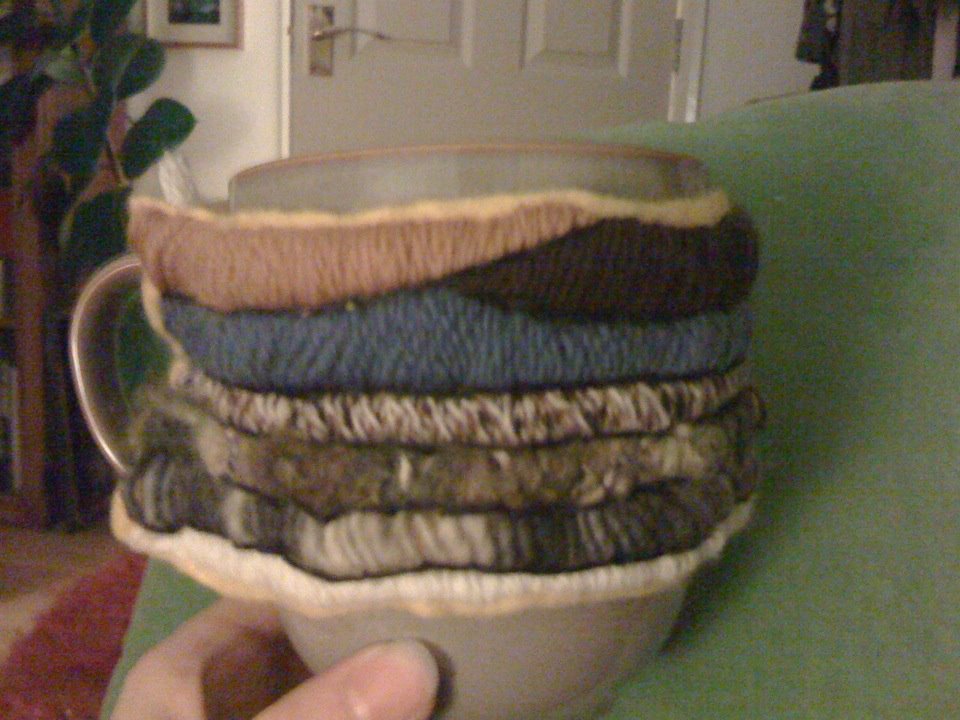
I personally am a keen crafter – knitting, crochet, quilting – you name it, I’ll stitch it. now you may be thinking – geology and crafting aren’t natural bedfellows, how do you use this as an analogy? Well I have made many geology based crafty things, but my crowning achievement in terms of sharing a geological idea, was a mug hug I made for my friend Sally. Now if you haven’t heard of a mug hug, they are bits of quilted or knitted fabric that you wrap around your mug of tea to keep it warm. They are usually bright and cute and come in a variety of patterns but this wasn’t enough for me – no, I wanted mine to be geological. So I looked into some patterns and then thought – heck. I’ll do her a cross section. So I downloaded some borehole logs from the British Geological Survey and created a geological cross section mug hug for Penge, where my friend Sally lives…..

Sorry the photo was taken with a phone, but you get the idea!

Sorry the photo was taken with a phone, but you get the idea!

It might seem strange, but it looks good and I gave her a key to allow here to interpret the types of rock and understand the scale I used. Nerdy, yes. But she liked it and it’s a good way to get geology and craft to get together and make beautiful magic – I have since experimented with other cross sections and have almost finished a geo-quilt (hopefully more on that later)! But crafting isn’t for all of us and to be fair is also quite a niche area. However it was reading another post that set me off thinking about this subject in the first place, and that was the post of Deborah Blum  all about Science Writing. In her post she discussed the different methods of science writing and how she likened science writing to telling a story and at one point she mentioned that her book, The Poisoners Handbook, was nominated for a murder mystery award. That led me to think – the one thing that pretty much all people have in common is that they like a good story, whether it’s crime, horror or romance; biographical or dramatic; a celebrity scandal or the neighbours’ gossip, stories are loved by all humanity and we trade them constantly, with all kinds of people. So my question to you is this, can you tell me a story? And not just a story of science, but a story WITH science?

You think it’s not possible? I have three letters that prove you wrong. C. S. I. Who would have thought a mainstream TV show with a viewership of millions would be regularly breaking out the mass spectrometer or examining the reproductive cycle of the common fly? The central character of the original C.S.I. series is an entomologist who has specimen jars scattered liberally around his office. AN ENTOMOLOGIST! OK the science is occasionally dodgy, and they seem to have no notion of contaminating a crime scene, but in this show, as in many other spin offs, science sits comfortably within the narrative. It isn’t intimidating, it isn’t boring and it progresses the story in a way that often makes it that star of the show. So I ask you if C.S.I. can do it, why can’t we?

Now all I need to do is come up with a gripping storyline involving geology and robots……….

It’s been a long train journey…

So. Welcome. I am currently sat on a train racing though the beautiful UK countryside nearing the end of a twelve and a half hour journey (and that’s just the train) and during this journey I have had an epiphany. You see this train, very unusually, has wifi, so I have spent my time on board actively reading my journal articles (check my good behaviour!), checking the news and scoping out blogs of writers I admire, and my epiphany was this: If I want to get better at science communication and really get a handle on all this data I am processing daily I should be writing about it. And not just as an academic, but as an interested and curious person. So I have decided to add my little slice of pie to the immense blogosphere patisserie and see what comes back. Maybe nothing, but maybe you lovely people will have a look at my ramblings and share some of your own inestimable knowledge and experience.

So there you have it. In Big-Bang-stylee I like to call it the ‘clickety-clack tremor inspired revelation’. As I am still on the train I will save the first instalment for another day when I am more compos mentis.

All that remains to be said is – thanks for reading.

Hazel

How to use a geological map (or where to find an ammonites armour).

When you go fossil hunting, one of the most important things to do is to know what you are looking for. There is no point in looking for a Mammoth skull in a place where the geology is not old enough for Mammoths to be buried there. It’s the same idea as not going fishing in a desert (though geologists sometimes find fish in deserts, but that’s another story). No, in order to know what fossils you expect to find, you need to know about geological maps.

Geological Maps of Britain 1:625 000 Scale BGS

These maps show the bedrock geology – the geology under the soil – for Scotland, Wales, Engand and a bit of Northern Ireland (sorry – overlap is obscuring most of NI)

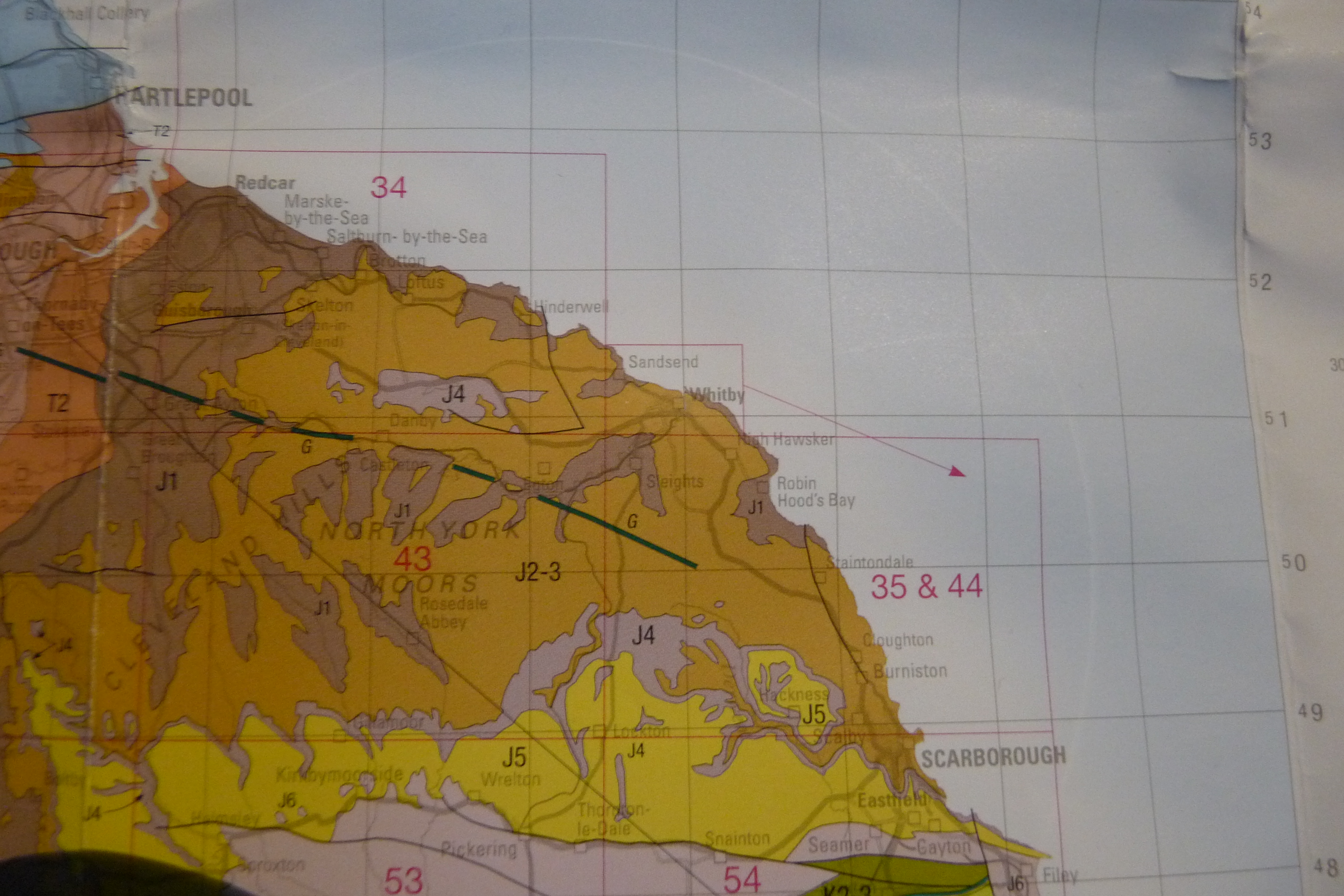
This is a geological map of Britain. You may realise that it looks a lot like a normal map, except that instead of roads and countryside it has strange bands of colour swirled across it. These bands of colour represent the geology, but I’ll get to that in a minute. First you need to find out where you are on the map.

For argument’s sake I am going to choose Whitby, because I know that is a good place for fossil hunting, but you could start by looking where you live, or somewhere you really want to go looking for fossils (by the way if you don’t have a geology map of your own and can’t find one in your library you can use the digital one on the British Geological Survey website – it’s not as detailed, but you get lots of great extras).

The geology of Whitby

This shows a close up of the geology around Whitby.

So take a closer look at your area. As you can see in this photo the colours on the map around Whitby are:

  • A purpley brown with the letters J1 written in the space
  • An orangey beige with the letters J2-3
  • A light purple with J4
  • A yellow with J5

Which is all well and good, but what does it mean? And how does this help us find our ammonite? Well just to give us context, if we zoom out from Whitby a bit you can see that the nearby area also has greenish bits with ‘K’s on them and pinkish-orange bits with ‘T’s on them.

The geology between Hartlepool and Flamborough Head

This map has zoomed us out a little bit to show some of the other colours in the area.

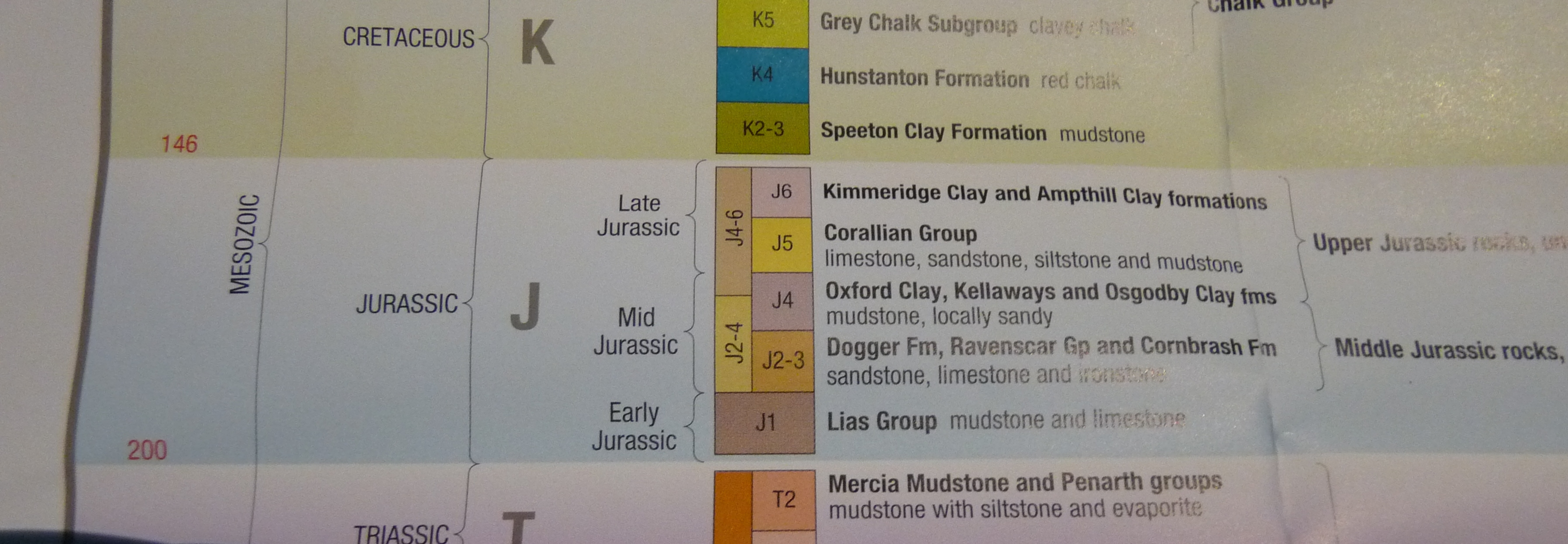
To find out what this means we need to look at the legend at the side. This is like the key and tells you lots of useful information. Let’s start with what the colours mean.

BGS Bedrock Geology North UK 1:625 000 legend

This is the legend for most of the rocks on this map (there is more but I couldn’t fit it easily on one image)!

Well the first thing that I always notice when I look at the legend of the map is that the colours are all arranged roughly together (there are oranges, blue-greens, beiges, and purples), and that the letters are grouped together as well. So if we think about the ‘J’ letters we were looking at, you can see that they are in the purple-brown section and are linked to an era called Jurassic. This is the geological age of the rocks in this area – it means that all the rocks with a J on them are Jurassic.

This word will probably be familiar to you if you go fossil hunting because here in this country we get a lot of fossils from the Jurassic – including ammonites! So we know we are on the right track. If we look around the Jurassic section, you can see those pinkish-orange colours by the big T are related to the Triassic and the greenish colours above with the K are related to the Cretaceous. Now although you can find fossils in these areas they are a bit far from Whitby, and I think we will find some interesting fossils in the Jurassic age rocks; let’s stick with them.

Zoom in on the legend

This is close up of the part of the legend that relates to Whitby on the map.

So going back to Whitby, if we want to find some fossils we need to know what kind of rocks to look for. Now to start out at the basic level, we already know we need to find a rock made of sediments (mud, sand, clay etc – the sedimentary rocks) because any rock that has crystals in it (like a granite or a marble) can’t have fossils (those are the igneous and metamorphic rocks). I’ll go into that more later, but first we are thinking about Whitby. So if I look back at my map I can see that the rocks immediately around Whitby are purpley brown with J1 on them. If I read that section of the legend it says:

Early Jurassic {  J1   Lias Group  mudstone and limestone

Ok well the first part (Early Jurassic) is just telling us the age of the rocks. This means these rocks are the oldest in the Jurassic period – if you look to the left a little you can see that the Jurassic started approximately 200 MILLION YEARS AGO!! The second is our letter that led us here. The third is the geologist’s name for these rocks – the Lias Group – it helps geologists to link different rocks together and match them across different parts of the country. The fourth part is the most helpful. Mudstones and limestones.

Shale with bivalves and ammonites

This is a type of mudstone – a shale – with lots of little fossils in it.

This tells us the type of rocks we are looking for – mudstones are stones made of mud (obvious huh?) that are brilliant at preserving fossils and limestones are rocks that are pretty much made of fossils. As a quick guide, mudstones are usually grey (especially in this part of the country) and form lots of layers in rocks. They can look a bit like slate but are very easy to break apart. Limestones can be grey, white or cream coloured depending on the fossils, but fossils in them can be pretty small and sometimes are really broken up, so we are going to focus on the mudstones.

So we know where we want to look – Whitby – what era the rocks will be – Jurassic, specifically Early Jurassic – how old they will be – about 200 million years old (specifically between 201-175 million years old) – and what type of rocks we are looking for – mudstones.

So when we go searching here do we know what kind of fossils to expect to find? AMMONITES! Just like Dactylioceras. This means we probably aren’t going to find a mammoth skull here, the rocks are too old! Same for looking for desert rocks, these rocks are too young for that period of our history. So by looking at a geological map you can know what type of fossils you should expect to find.

Geological maps are useful for lots of other things too, but I just want to go back to those bands of colour we saw on the first image. If you are really interested in finding ammonites, but had already looked in Whitby; a geological map can show us where in the country to find rocks of the same age (Jurassic) or type (Lias Group). You see that big purple swathe across the country down to Dorset? Those rocks are all Jurassic. So in theory you could find ammonites anywhere along that line! But remember only some places are safe to collect in, so check before you go running off to your nearest patch of purple-brown!

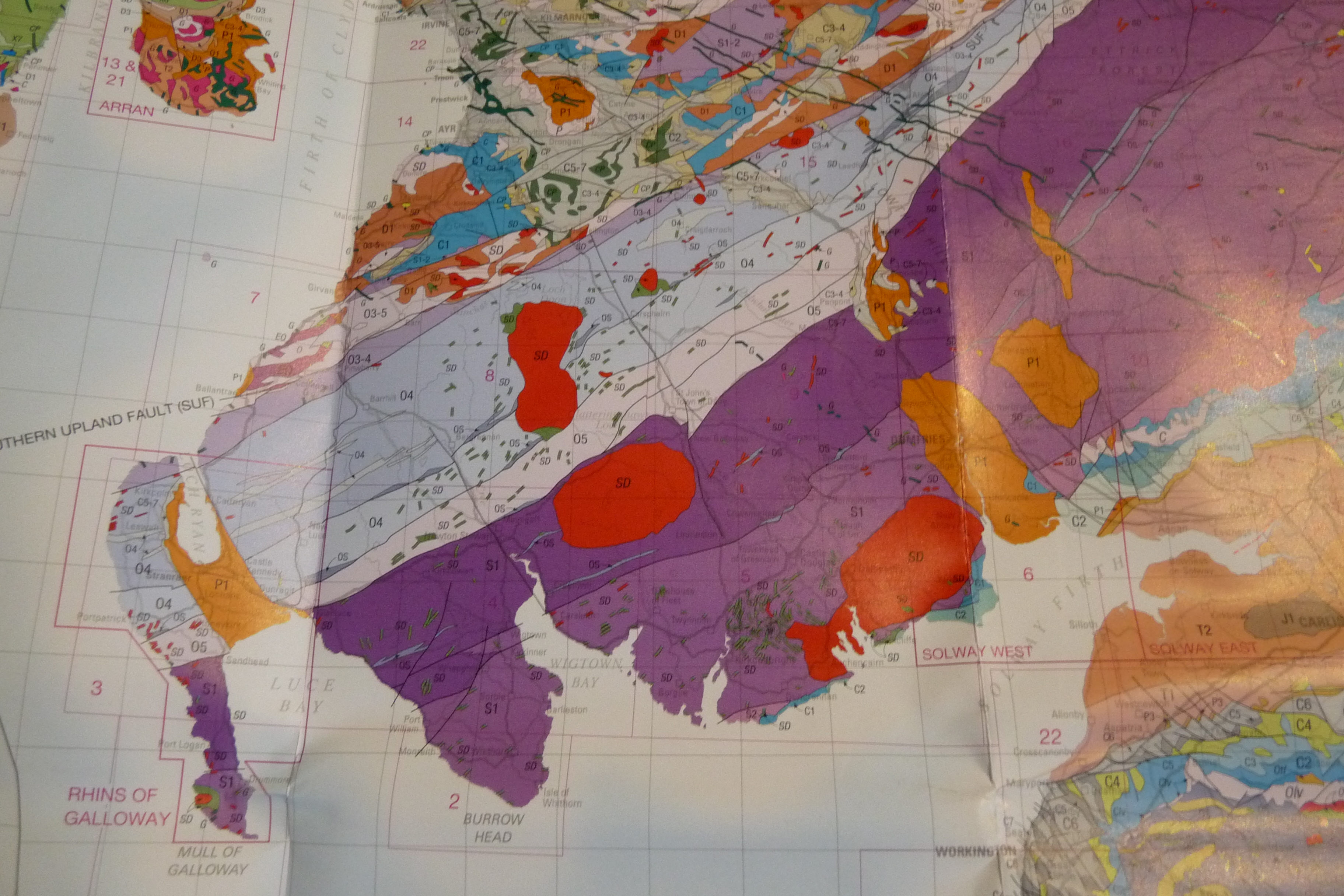
One final thing to point out is that if you live in certain places you aren’t going to find any fossils. These are places that have igneous or metamorphic rocks and you can spot them on your map initially by looking for the big red blobs.

Igneous provinces in the Lake District

These big red blobs mark where volcanoes used to be and are a sure fire way to find some brilliant rocks and minerals – but no fossils.

Although you are not going to find any fossils in the red blob areas you will find some fantastic volcanic rocks and some amazing and even sometimes really rare minerals and crystals.

If you want to find out more you can check out the British Geological Survey‘s webpage, they have loads of info on the maps they make and even lots of digital ones you can take with you. Check out this pamphlet they produce as well for more in depth information.

BGS - A short Guide to Geological Maps

This pamphlet on geological maps is produced by the BGS.

So there you have it – maps, a geologist’s best friend – and that is how you find an ammonites armour.

Have a rockin’ day!

(this post was moved from my old site, so sorry for any inconsistencies)